Custom lithium battery packs engineered to your equipment specification.
A specification-led OEM service for LiFePO4 and project-dependent lithium-ion packs—from requirement review and prototype validation to controlled production supply.
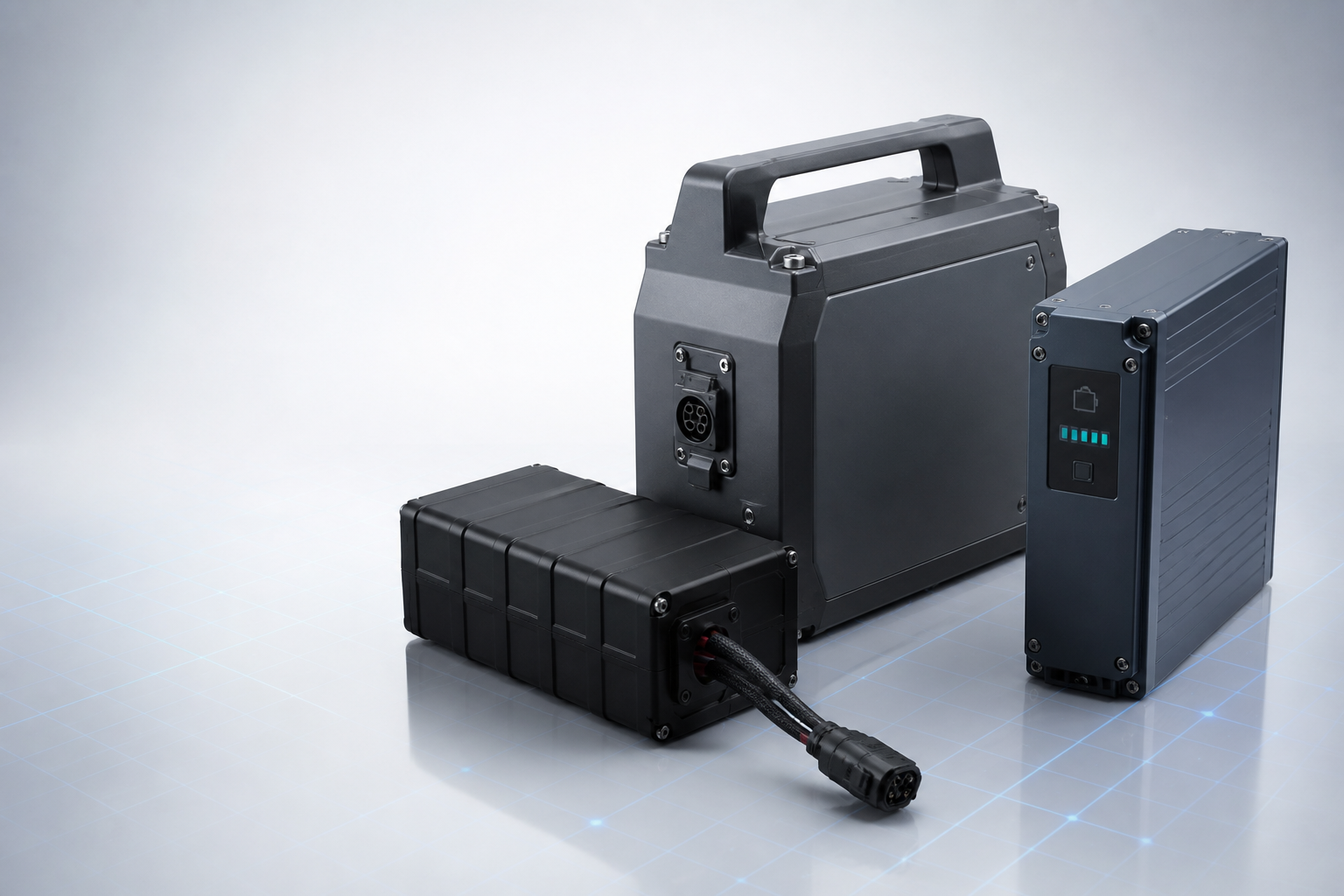
The pack follows the equipment requirement—not a generic size chart.
We review battery chemistry, series and parallel configuration, nominal and charge voltage, usable capacity, continuous and peak current, BMS functions, host communication, enclosure, connector, cable exit, mounting, environmental exposure and target-market documents as one system.
LiFePO4 is the primary platform. Other lithium-ion systems are evaluated only when the application, space, load and lifecycle target justify them. A request for a “battery with BMS” is therefore a starting point, not a complete compatibility claim.
From incomplete requirements to a controlled production specification.
Commercial commitments follow technical definition; fixed online pricing or a universal MOQ would ignore the work that changes from project to project.
Define the duty
Translate equipment load, charging behavior, runtime, environment and lifecycle priorities into measurable requirements.
Select the architecture
Review cell platform, S/P arrangement, current path, protection, communication, enclosure and service interfaces.
Prototype and verify
Build samples against agreed drawings and test conditions; resolve equipment integration before approval.
Release and control
Freeze the approved configuration, inspection points, documents, packaging and change-control route for repeat supply.
Voltage and amp-hours are necessary, but they do not define a safe pack.
The current path must survive continuous and transient loads without unacceptable voltage drop or heat. Cell spacing, interconnects, enclosure, sensing and cooling affect temperature distribution. Protection thresholds, contactors or MOSFETs, precharge, isolation, charging interlocks and fault handling depend on the system architecture.
Validation is agreed around the actual design: electrical limits, thermal behavior, mechanical fit, communication, charging, environmental exposure and production acceptance criteria. Transport and market documentation is confirmed for the exact configuration and destination, not borrowed from a similar battery.
Go deeper before sending a complex RFQ.
Have an equipment requirement?
Send what you know now. Engineering can identify the missing decisions before quotation.