How to specify a BMS for a lithium battery pack.
Define the chemistry, series count, current, sensing, protection, balancing, execution architecture, communication, charging and validation before selecting hardware.
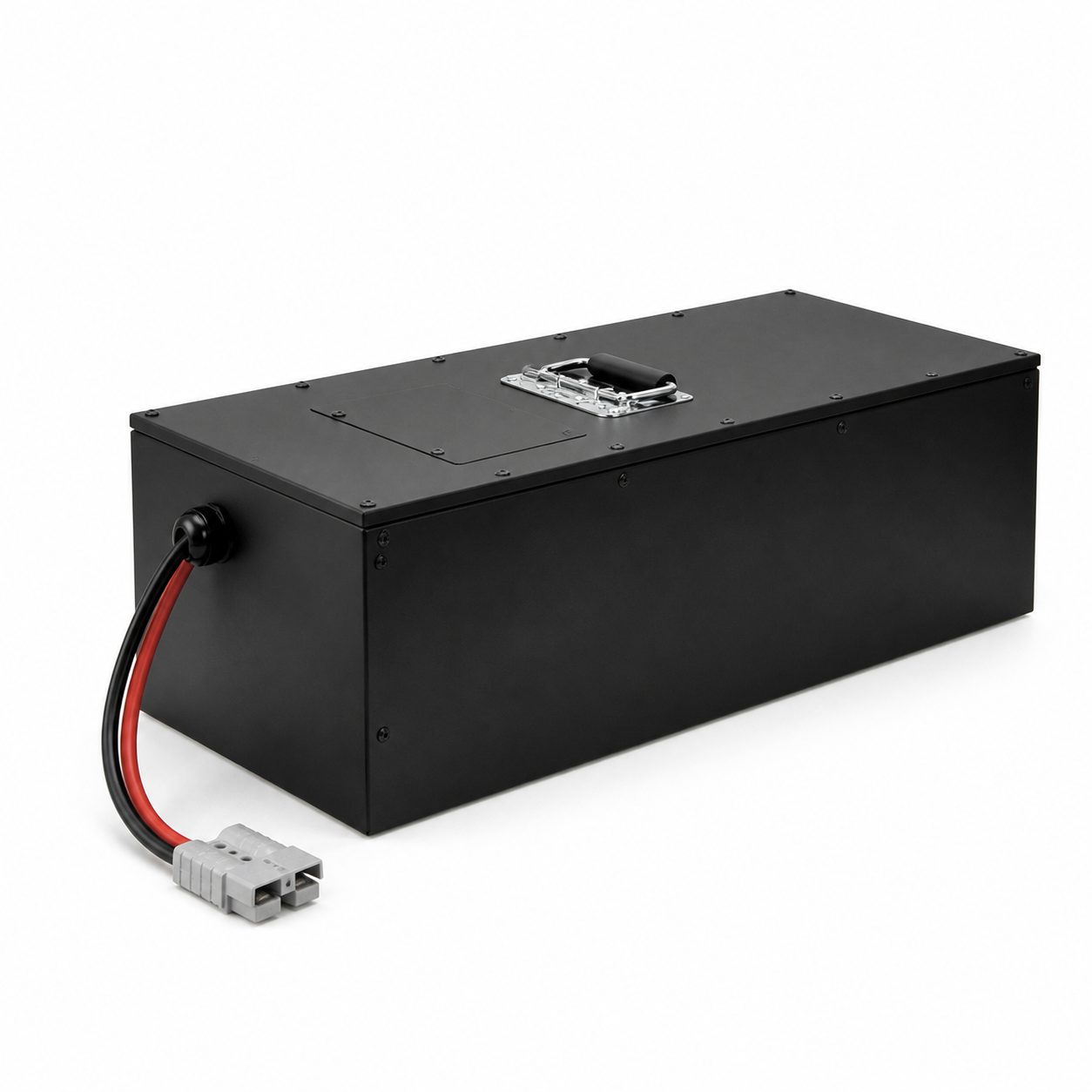
Specify the battery system first; the BMS follows its chemistry, topology and hazards.
A BMS commonly monitors cell/group voltage, pack current and temperature; detects conditions outside defined limits; controls MOSFETs or contactors; balances cells; estimates state; communicates with chargers or host equipment; and records faults. Which functions are required—and their thresholds, accuracy, redundancy and response—depend on the pack.
“BMS for 12V, 24V, 48V or 72V” is incomplete because market voltage names do not uniquely identify chemistry or series count. A 4S LiFePO4 pack, 3S lithium-ion pack and high-voltage contactor system need different architectures.
Separate monitoring, protection, gauging and system control.
One integrated device may perform several functions, but the specification should state each responsibility.
| Monitoring | Cell/group and pack voltage, charge/discharge current, sensor locations, range, accuracy and sampling. |
|---|---|
| Protection | Over/under-voltage, over-current, short-circuit and temperature detection, delay, action and recovery. |
| Balancing | Passive/active method, start conditions, current, thermal impact and production/service goals. |
| State estimation | SOC/SOH inputs, accuracy conditions, learning/calibration and behavior after storage or replacement. |
| Diagnostics | Fault codes, event history, service data, configuration and access control. |
Translate 4S, 12V, 24V, 48V and 72V names into exact chemistry and series count.
Full-charge voltage and switching/insulation architecture matter more than the market label.
Low-voltage MOSFET
Common in compact and 4S/12V-class packs; current, thermal design and charge/discharge port arrangement matter.
24V/48V families
Confirm whether LiFePO4 or another lithium-ion chemistry and the exact series count.
72V/traction
Review higher-voltage switching, precharge, contactors, insulation, service disconnect and host control.
High-voltage systems
May require distributed cell monitoring, master control, isolation monitoring and coordinated safety states.
Make BMS, charger and host behavior explicit.
A smart BMS protocol is useful only when both sides implement the same messages and fault behavior.
| Charging | Voltage/current commands, charge-enable, temperature interlock, low-temperature behavior and charger timeout. |
|---|---|
| Host communication | Physical layer, bit rate/address, DBC/register map, messages, update rates, alarms and fail-safe. |
| Thermal control | Sensor locations, fan/heater outputs, derating and shutdown coordination. |
| Contactors/precharge | Sequencing, feedback, weld detection, fault opening and stored-energy handling where applicable. |
| External vs internal | Define whether protection is inside the pack, equipment or both, and prevent gaps or conflicting actions. |
Test the BMS inside the final pack and equipment context.
Bench protection trips alone do not prove system integration.
Measurement
Accuracy and plausibility across voltage, current, temperature and operating range.
Protection
Normal limits, credible faults, delays, recovery, latching and fail-safe states.
Communication
Startup, timeout, corrupted/lost messages, alarms, commands and software/configuration control.
System
Charger, host, contactors, thermal controls, parallel units, service and end-of-line production tests.
Practical procurement questions.
Do all lithium batteries need a BMS?
A lithium battery system needs appropriate monitoring and protection responsibilities. The implementation may vary by cell, pack and host architecture, but operating an unverified pack without defined protection is unsafe.
What BMS do I need for a 48V lithium battery?
First confirm chemistry and series count, full voltage window, current, switching architecture, sensing, communication, charger and equipment behavior. “48V” alone is insufficient.
Is a BMS the same as a charger?
No. The charger supplies controlled energy; the BMS monitors and protects the battery and may communicate limits or permission. Their functions must be coordinated.
Can BMS settings be copied from another pack?
Not safely by default. Thresholds and logic must match the exact chemistry, cell, series count, current architecture, sensors, charger, host and validation evidence.
Official references used for this guide.
Always confirm the current rule, exact model and destination before relying on a document.
- Texas Instruments: battery monitor, protector or gauge — explains functional boundaries among monitoring, protection and gauging.
- Texas Instruments: BMS monitoring, protection and balancing — describes common BMS functions; project thresholds and architecture still require validation.
- NREL: Li-Ion Battery Thermal Characterization for Thermal Management Design — thermal behavior must be evaluated at cell, interconnect and pack level; the research is not a product test report.
Need a BMS defined for a complete battery pack?
Send the chemistry, voltage, current, architecture, communication, charger, host and validation scope.